
By: Andy Davis
All-Day Regional Express Service Helps Connect Lake County to Cleveland
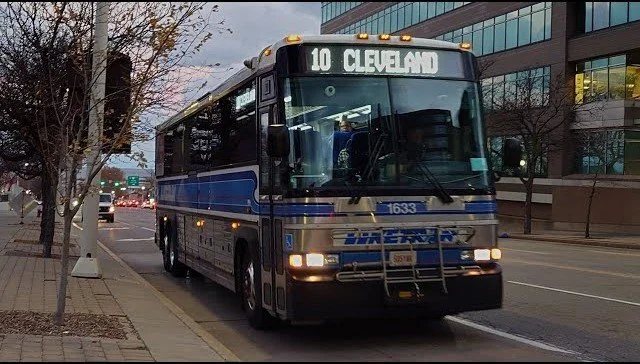
As mentioned in previous articles, there is a major shortcoming in Lake County’s public transit configuration: an all-day connection to Downtown Cleveland. Currently: outside of the Park-N-Ride hours that are centered around the 9-to-5 commuter, there is one singular “all-day” connection between Laketran and the RTA: at the Shoregate Transit Center: Where the RTA’s 10 Bus and Laketran’s 3 and 6 Buses. And even then, the 10 doesn’t go to Downtown Cleveland, it connects to the RTA’s Red Line, HealthLine, or a few other bus routes that go to Downtown. That’s a THREE seat trip, just to get to the city center outside of “normal” commute hours.
So, this current configuration begs the question: How can we better connect Lake County’s municipalities to Cleveland? The obvious answer, the one that us at LCPT will continue to beat the drum for, is a Regional Rail line. However with current transit funding, or lack thereof, that’s a pipe dream.
With that reality, we alter the question at hand: How can we better connect Lake County’s municipalities to Cleveland in the short-term? And the answer presents itself: An “express” bus between the RTA’s Red Line rapid transit and Lake County.
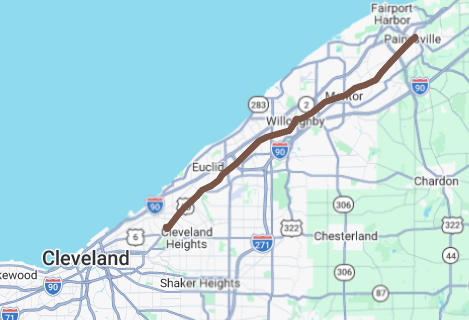
The Route
The route utilizes the arterial road of U.S. Route 20. It starts at the Painesville Transit Center in Downtown Painesville, and follows the Laketran’s 1 Bus’ route all the way to Great Lakes Mall, where it deviates from the 1 bus by remaining on Route 20 instead of deviating towards Lakeland CC. Then, the route goes through Downtown Willoughby and Willoughby Commons. After serving a part of Wickliffe to the county line, the bus is then able to commence express service all the way to the Louis Stokes-Windermere RTA Station. The station sits as the eastern terminus for the RTA’s Red Line train and the HealthLine bus. At that station, a bus loop already exists for the HealthLine and other RTA local routes.
From there, passengers coming from Lake County are able to choose between the HealthLine Bus Rapid Transit route and the RTA’s Red Line Light Rail route. The Red Line also connects Cleveland Hopkins International Airport, the future Browns’ stadium, Little Italy, and Ohio City. The HealthLine connects University Circle, the Cleveland Clinic, Midtown, and Playhouse Square.
In order for this route to work, it cannot solely operate inside normal Laketran operating hours (5am to 9 pm). A 9 pm cutoff would discourage sports fans, concertgoers, theatre enjoyers, and many more from using the route. Something along the lines of a 30-minute frequency between the hours of 5 am and midnight would suffice for proper service, which increases in frequency at peak daytime hours.
Operational Benefits
For Laketran, the implementation of this proposal would help cut down costs that have plagued the transit authority post-COVID. Park-N-Rides aren’t utilized by the Lake County population, as hybrid and remote work have diminished the demand for 9-to-5 services. Some local routes should see better frequencies, which could help incentivize transit-oriented development along populous corridors. This 1B proposal would complement the 1 (Would be called 1A) Local Route in that sense. It allows for better service along the Painesville-Mentor corridor, while providing an avenue for all day service to Cleveland. So, Laketran gets to save vehicle hours by being able to cut Park-and Ride routes, the Sports Transit Express, etc. while providing better service.
Why not advocate for better hours and service on Park-and-Ride routes?
Park-and-Ride routes, despite being a sector of public transit, are still considered car-dependent infrastructure. Stations are in parking lots, meaning that a car is required to access, with little-to-no walkable sites around the stations. On top of that, PnRs only offer one-way service during commuter hours, with no mid-day service due to lack of demand. For us in Lake County, the PnRs are our only direct connection to downtown, leaving the densest parts of Lake County (Downtowns) out to dry. The 1B proposal would bolster the transit that will help cultivate urbanist developments in areas that welcome urbanist investments. Instead of solely connecting the suburban parts of Lake County to the big city, this line allows for connections to and from the densest parts of Painesville, Mentor, Willoughby, Wickliffe, and allows for other Laketran routes to follow suit in the future.
Even if I own and use a car, how would this route help me?
This route would get more cars off the road, plain and simple. Although Cleveland traffic is good for a big city, there’s still plenty of congested areas that make driving a hellscape. During rush hour, I-480 is always at full capacity, Dead Mans Curve usually has a 10-15 minute delay during peak times, and one single accident can cause region-wide back-ups in traffic. Also, this adds more flexibility and service hours for trips to-and-from downtown. As mentioned before, this route serves sporting events, the airport, and many popular destinations, on top of serving a major employment hub.
On top of that, better transit can act as an alternative for driving when car issues, injuries, and other disabling events prevent someone from driving. This strengthens the accessibility in and between Lake County and Cleveland, which boosts visitation of our great area.
Another thing to consider is ubiquitous with the general transit vs. cars development: negative externalities. In this argument, the negative externalities of cars include road decay, air pollution, noise pollution, and space usage. Cars pollute their surroundings via exhaust and noise, while highways take up large chunks of city land.
With climate change being more evident than ever, it’s only going to get worse from here unfortunately. A great way to be environmentally conscious is to use public transit when possible, even if it means adding 10-15 minutes of travel time. On top of that, gas prices continue to increase, which is where good transit can help with savings.
Conclusion
Although the idea of suburbs are widely unpopular amongst the urbanist community, I believe there is still a place for the suburbs in a great, connected, and transit-friendly region. However, in order for the suburbs to reap the benefits of urbanism and associated investments, they need a strong connection to surrounding communities and, most importantly, the metropolitan center. Currently, it takes around 2 hours to get between Painesville and Cleveland using local routes. That’s only useful to people who need to use the bus. In this proposal, the bus works both ways; bidirectionally. We highlight how Lake County can connect to Cleveland, however those in the Cleveland area can connect to all that Lake County has to offer, too.
